
When a lender adds information outside the traditional credit report, the total number of approvals can stay the same while different applicants get an offer. A useful access test therefore starts with two groups. Who would receive an offer under the new policy after a refusal under the old one? Who would lose an offer they would previously have received?
Compare decisions on the same applications
Choose one product, one decision period and one definition of an offer. Apply the old and proposed policy to the same applications using the information available on each application date. Record cases that cannot be scored because a data source is unavailable. Missing a bank-data connection, for example, should remain visible as its own outcome.
Use the four outcomes below for applications that both policies can score. Count unscorable cases separately and record which policy lacked the needed data.
| Old policy | New policy | What the reviewer checks |
|---|---|---|
| Offer | Offer | Changes in price, amount or repayment schedule. |
| Refusal | Offer | Which new evidence supported an affordable offer. |
| Offer | Refusal | Whether a new exclusion, data gap or threshold drove the decision. |
| Refusal | Refusal | Whether the reasons remain traceable and correctable. |
Read the study denominator before borrowing a result
In the published Invisible Primes study, Marco Di Maggio and Dimuthu Ratnadiwakara describe education and employment information as alternative data. They report that a US fintech platform approved 15% to 30% of low-credit-score applicants its traditional-model comparisons would have refused. The denominator is that low-score, traditionally rejected group. It excludes applicants already approved by the comparison policies. The range comes from the authors’ study and is neither a Caribbean benchmark nor a Credit Garden result.
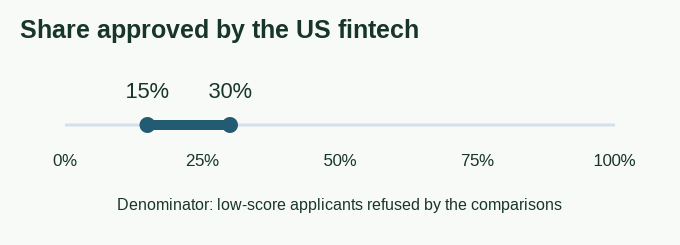
That result illustrates why a net approval count is incomplete. A new policy may find suitable borrowers who had little documented credit history. It may also add conditions that other applicants cannot meet. Check each direction of change, then compare the amounts, prices and terms offered. A loan that someone cannot afford does little to improve access in practice.
Keep uncertain repayment outcomes out of the result
A historical comparison can show who would switch groups. A loan the old policy refused has no observed repayment in these records, even if the proposed policy would have made the offer. The selective-labels research explains the general problem using bail decisions. In lending, that same measurement gap means a modelled repayment outcome must stay separate from an observed one.
For cases where repayment is observed, agree in advance on the outcome window and the definition of late payment or default. Report the loans that have reached the full window. Keep applications, accepted offers and funded loans as separate denominators. A policy can change who takes up an offer even when the initial approval rate stays fixed.
Decide what Charlie Bucket would need to show
Credit Garden’s proposed evaluation would start with the decision groups above. A credit officer should review a sample of changed decisions, record the reason and check whether the applicant could correct a missing or inaccurate input. Review results by relevant groups where the data can be used responsibly. Small groups need enough protection to prevent identification and enough context to show how uncertain the comparison is.
The credit-risk team should set affordability and loss limits before any approved live evaluation. Track missed payments, complaints and corrected decisions alongside offers and terms. If an access gain is visible only among applicants who can provide the new data, report that boundary. The prior Credit Garden article covers the separate question of which model or information source explains a change in ranking. No Charlie Bucket access or loan-loss result is reported here.
Sources and data
- Di Maggio and Ratnadiwakara, Invisible Primes: Fintech Lending with Alternative Data, published online 13 May 2026. Published abstract supplies the interval and the comparison group.
- Kleinberg et al., Human Decisions and Machine Predictions, open working paper, 2017, p. 8. The selective-labels example concerns bail decisions.
More research from Credit Garden. Add this site as a preferred source on Google.