
A new document requirement can slow some credit applications before a score is even calculated. A credit team that sees only completed files may miss those borrowers. Track who submitted, who was scored and who received a decision before using a single approval-rate table to judge the model.
Look for changes within the same loan category
The US Consumer Financial Protection Bureau analysed home-purchase mortgage applications reported under the Home Mortgage Disclosure Act. Its report on 2023 activity shows why monitoring needs more than a portfolio average. From 2021 to 2023, denial rates for conventional conforming home-purchase loans rose by 0.8 percentage points overall and by 2.3 points for applicants classified as Hispanic White. These are separate annual application cohorts. A disparity is a flag to investigate. The records alone leave its cause unresolved.
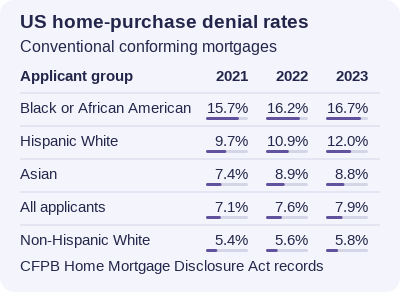
The CFPB table cannot tell a lender how a particular underwriting model treated equally risky applicants, or what repayment would have looked like for people whose applications were declined. A separate 2018 study by Lydia T. Liu and colleagues used a hypothetical lending model to show that an approval rule chosen to satisfy a fairness criterion at one point can have different consequences for borrowers' later credit scores, depending on repayment and on how lending changes scores. It is a reason to measure outcomes later. It supplies no estimate of those outcomes for Caribbean borrowers.
Keep the decision and repayment denominators separate
After each quarter, the lending analyst should freeze an export of applications for one product and channel as of a recorded date. Apply the same definitions and count each application once per stage. Retain the dates and versions of the score and decision policy. Split a quarter if either materially changes. Start with submitted applications. Report the number incomplete or withdrawn and the number with a missing score, each out of submitted applications. For this local audit, divide denials by offers plus denials and show pending files separately. Count every offer even if the borrower declined it. For take-up, divide disbursed loans by offers. Display every numerator and denominator.
For each quarter, use the same time since disbursement for repayment comparisons. For example, among loans old enough to have a complete 180-day observation window, count those that reached 30 days past due during that window. Calculate the rate using loans with enough servicing data to determine whether they reached that threshold. Report the number excluded for missing servicing data so a change in coverage is visible. Keep repayment for declined applications unknown. Use legally permitted group information only in a restricted audit, with small-cell protections and an explicit unknown group.
In an illustrative intake review, 20 of 100 submitted applications have no score. A file check finds that ten of the 20 include an acceptable document the intake system failed to read. The team can replay the same 100 files after correcting that input, with the score and underwriting policy fixed. If all ten now receive a score and all other results stay the same, ten of 100 remain unscored. This checks the repair. Offers and later arrears need separate measures.
Compare a candidate score before changing decisions
For a future Charlie Bucket evaluation, apply the current and candidate scores to the same applications in a later quarter the team did not use to build either score. Before opening that quarter’s results, set thresholds that serve the same policy objective and fix the other underwriting rules. In a committee table, report unscored files, where replayed decisions disagree and groups for which the evidence is too sparse to interpret. For the same set of disbursed loans with complete 180-day records, compare each model’s mean predicted probability with the observed share only if both scores predict the chance of reaching 30 days past due within 180 days. A proposed switch needs a documented decision about the discrepancies and a follow-up date for outcomes with enough time to mature.