Credit Garden published its Charlie Bucket evaluation review on 27 October 2026. Since the 26 October company update, this is the documented change: the public research now distinguishes a credit ranking from calibrated repayment risk, fairness and financial health. A lender can use that distinction to commission a test with a defined outcome.
No newer inspected loan-performance report establishes reduced losses, improved well-being or faster lending operations. The next proposed task is to prepare an evaluation brief that a lender can check. The proposed checkpoint below measures whether the required evidence exists before anyone reports a model benefit.
The financial-inclusion direction in January 2022
A company deck labelled 29 January 2022 set out Credit Garden's financial-inclusion direction, including education, AI-supported risk assessment and a Charlie Bucket model for people with limited conventional credit history. The dated deck described the model as entering live testing. That statement records the company's position at the time. It does not establish that testing was completed or that a present production model has been independently validated.
This is a retrospective planning and development milestone. The private source is retained in the founder archive; this public update summarises its scope without releasing the confidential deck, customer information or commercial assumptions. The archive's early ambition should be assessed against dated evaluation records when those become available.
What the new publication makes usable
The new review follows our alternative-credit-data evidence review. Together, the articles give a credit team questions to ask before treating alternative data as proof of financial inclusion. A useful variable must be available with permission, measured before the decision and relevant to an outcome the lender has defined.
For an unbanked or underbanked applicant, an absent conventional record is a missing source of information. It is not proof of high repayment risk. A test should retain how missing information was handled and identify people for whom the model cannot support a reliable estimate. An explanation and review route matter when a decision affects access to finance.
Financial health needs its own definition. Repaying a loan on schedule does not by itself show that a household has a greater ability to manage expenses or withstand a financial shock. A future borrower study would need consent, a suitable instrument, a defined follow-up period and a comparison that addresses the question being asked. This update reports no new borrower survey or well-being finding.
Loan losses and operating time are different outcomes
To test a loss claim, a lender would need a defined loan cohort, comparable decision policies, observed repayments and an agreed loss measure over a stated period. A model that ranks borrowers well in one dataset has not necessarily reduced losses under a new approval policy. Changes in lending volume or the people approved can alter the result.
Operational efficiency requires a separate record. Define when a case enters the process, what counts as completed work and how exceptions are handled. Include human review and correction time. An assistant that drafts a response quickly may still require substantial checking before the response can be used.
The Charlie Bucket programme can therefore ask a specific question at each stage: does the available evidence support the score, the lending decision, the borrower outcome or the process change? The answer may differ between stages. Keep the comparison and uncertainty beside each claim so a dashboard cannot silently join them into a single benefit.
What a fintech collaboration would need to establish
Fintech collaboration remains a programme interest. This week's inspected evidence does not establish a new signed partner, new data-sharing agreement or completed lender deployment. A future public announcement should identify the parties' precise roles, permission to name them and the dated activity actually completed.
Before evaluation, the team would also need a permitted data definition, access controls, a model version and a policy for applicant review. Keep identifying borrower records out of the public package. Publish methods and permitted aggregate results only after checking confidentiality and the possibility that a small group could be identified.
The next measurable step
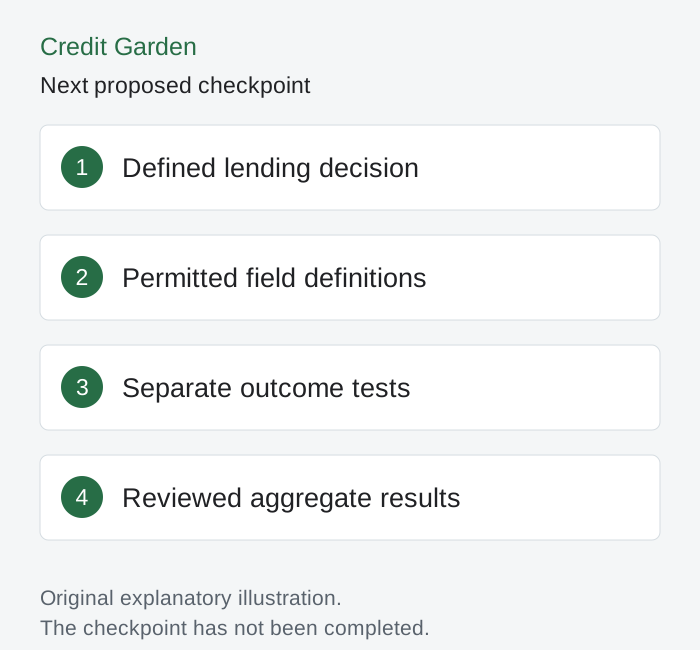
Our proposed checkpoint for 5 November 2026 is a readiness audit of 10 permitted field definitions for a future Charlie Bucket evaluation. These are documentation fields, not 10 borrowers, and the checkpoint does not validate the model.
- Write the decision, repayment outcome and observation window. Name a separate financial-health question if the evaluation will address one.
- Audit each field's definition, permission, availability date and missing-value rule. Count complete and unresolved definitions against the fields actually reviewed.
- Define the baseline and later evaluation period before examining outcomes. Record how performance and error uncertainty would be assessed for relevant, lawfully collected groups.
- List the process timestamps needed to test operating time. Keep that test separate from the repayment and well-being analyses.
The completed change is the new public evaluation review. Current model calibration, group-level error evidence, realised loan losses and borrower financial-health outcomes remain unverified. The next research task is to establish which permitted records can answer those questions.
Sources and publication status
Company archive reviewed 29 October 2026. The following dated records are company-reported evidence. Public summaries are provided here; private source documents and identifying records are not redistributed.
- Credit Garden financial-inclusion deck (29 January 2022 deck label): Company-reported direction and entry into testing; no current validation or realised benefits established.
Weekly startup update by Adrian Dunkley. Research status: public narrative explainers and proposed checks; no new company empirical results, completed meta-analysis or peer-reviewed company study is reported. Prepared with AI assistance and editorial source checks.
Read the Credit Garden archive. Related programmes: StarApple AI and Adrian Dunkley. Add this site as a preferred source on Google.