
A borrower who sees “credit score too low” may have no way to tell whether the lender used a wrong balance or applied a policy they did not meet. The difference determines who can review the case and what the borrower needs to show.
Trace the reason back to the decision
A notice should come from the lender’s decision record. That record should show the rule or model version, the values the lender used and any change a reviewer made. A model may flag high credit use, for example, but the lender may have declined because required income evidence was missing. Reporting the model’s strongest signal would send the borrower to look for the wrong problem.
FinRegLab’s 2023 study of explanation tools assessed whether methods for identifying key inputs gave a faithful account of credit model behaviour. One test checked whether applicants with similar values on the four inputs named by a tool were also rejected by the model under the study’s cutoff. Another changed the named inputs and compared the change in predicted default with changes to random or closely related inputs. Performance varied across models and tests. The study evaluated explanations for model inputs without mapping them to the reasons a lender would give a borrower.
Count changes to a record separately from changes to a score
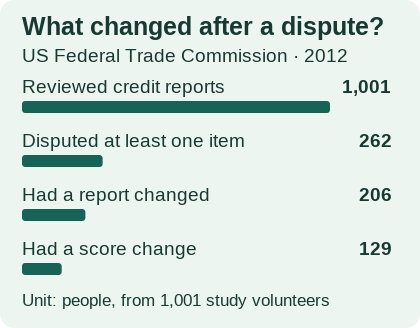
In the US Federal Trade Commission’s December 2012 report on credit accuracy, 1,001 volunteers reviewed their credit reports with study associates. Of those, 262 challenged at least one item. Following the dispute process, 206 had a report changed and 129 had a score change on at least one report. A corrected report can matter even where its score stays the same. The study did not establish how many people obtained a loan after disputing an item.
Send the borrower to the team that can fix the record
Consider a borrower whose notice refers to a late payment on a credit bureau report. The notice could give the reporting period and explain how to identify the entry in a secure channel. The borrower can compare it with a payment receipt or account statement. In Jamaica, section 16 of the Credit Reporting Act allows a consumer to complain to the credit bureau in person or in writing about inaccurate or incomplete information disclosed by that bureau.
A missing payslip or a value entered by the lender needs a different route. The notice should give the lender’s own review contact and specify what record needs checking. If the information changes, a reviewer should rerun the relevant decision under the lender’s applicable policy and tell the borrower what changed. A corrected input can leave the decision the same.
Test a notice before using it with applicants
For a proposed Charlie Bucket test, prepare two versions of a notice for each sample case and keep the underlying decision fixed. One version gives the current reason alone. The other identifies the source and period of the input, and gives the channel that can investigate it. Use sample records that contain no customer data. Include a wrong bureau entry, an internal data entry mistake, and a correct record with a policy requirement the borrower has not met.
Assign participants at random to one version. Ask them to show which fact they would check, who they would contact and what they would supply. Give the person scoring the responses a reference answer for each case. Count how often participants choose the correct route and how long they take. Then have an independent reviewer compare every reason against the decision log. Hold any notice that names the wrong reason or sends sensitive documents to an unsuitable channel.
A separate follow-up would have to track which disputes reached a reviewer, which records changed and whether the lender made a different decision. Credit Garden has yet to report results from this proposed evaluation.
Sources and related research
- FinRegLab, Machine Learning Explainability & Fairness: Insights from Consumer Lending, July 2023. Sections 3.2 and 4 explain the evaluation and results for adverse action notices.
- US Federal Trade Commission, fifth interim report on credit report accuracy, December 2012. Section 6 gives participant counts.
- Jamaica, Credit Reporting Act, 2010, section 16. See also the Bank of Jamaica’s credit reporting FAQs.
- Who gains a credit offer when a lender adds data? Credit Garden’s earlier article on tracking the decisions a lending policy changes.
More research from Credit Garden. Add this site as a preferred source on Google.