A lender can observe whether a payment arrived on time. Financial well-being asks a broader question about a person's ability to manage financial demands and choices. Credit Garden needs a measure of that outcome if it wants to evaluate financial health alongside Charlie Bucket's credit decisions.
The US Consumer Financial Protection Bureau's May 2017 technical-report page describes how its Financial Well-Being Scale was developed and how its scores and inferences were evaluated. The current public questionnaire contains ten questions and compares the result with US adults. It also changes scoring by age group and whether the questions were self-completed or read to another person. Those conditions matter when a team considers using the instrument elsewhere.
What you need to preserve
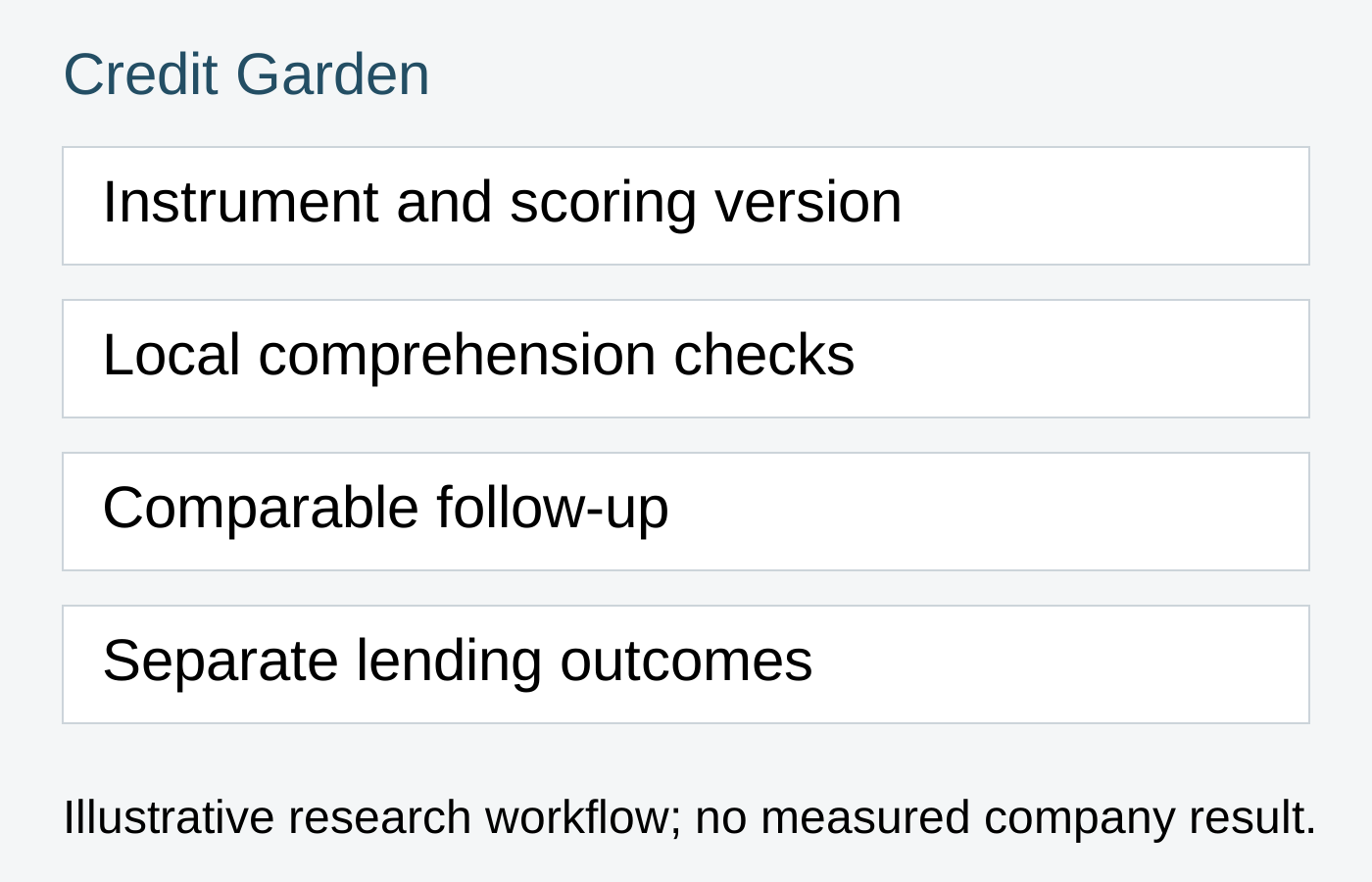
An established questionnaire is more than a list of questions. Item wording, response options, administration and scoring are part of the measurement. Rewording a difficult item may improve comprehension while also changing what the response means. Keep the original version and document every adaptation before interpreting a local score.
The public tool distinguishes ages 18–61 and 62 or older. It also asks how the questionnaire was completed. That demonstrates why a team should retain the scoring conditions rather than treating a total as an interchangeable number. Our inspection of the public tool and report landing page does not reproduce the full technical validation or establish validity for a Caribbean population.
Test meaning before comparing averages
For a proposed Credit Garden study, begin with a precise decision: will the measure describe the people using a service, track change over time or estimate an effect of that service? These purposes need different evidence. A score that describes a group today does not establish that a loan or an AI tool changed their financial well-being.
Ask permitted volunteers to explain what each adapted item means in their own words. Record misunderstandings without retaining unnecessary financial details. A person may interpret a term through household obligations, income timing or the help available from family. These are possibilities to investigate through interviews, not assumptions about any country or community.
Translation requires its own review. Check that the response categories preserve their order and meaning, and have a reviewer compare the translated version with the original. Do not pool scores simply because translated items look similar. A later psychometric study should examine whether the instrument measures the intended construct consistently across the groups being compared.
Keep Charlie Bucket's outcomes separate
A financial-well-being response should not silently become a creditworthiness label. An applicant may report financial strain while making payments; an approved borrower may repay while cutting essential spending. The research should define the outcome and the permitted use of each field, with a clear boundary between service evaluation and lending decisions.
Our Charlie Bucket evaluation review separates ranking, estimated repayment risk, fairness and borrower outcomes. This article adds a measurement question: would a change in the questionnaire score mean what the programme claims? It reports no new borrower survey or model result.
If a future evaluation compares scores before and after a service, retain the administration mode and version at both points. Report who answered at follow-up and who was lost. People who stop responding may differ from those who remain. An average among completers alone cannot establish improvement for everyone initially enrolled.
Choose a comparison that fits the claim
To estimate a service effect, declare a credible comparison and observation window before inspecting outcomes. Record other changes that could affect the result. A programme launched during a change in income or living costs cannot assign every later score difference to its own intervention.
For loan-loss or efficiency claims, retain separate outcome records. A questionnaire cannot substitute for observed loan losses or elapsed processing time. A useful report can bring these measures together while preserving their populations, dates and definitions. No composite benefit should conceal a worsening borrower outcome.
A proposed comprehension check
By 6 November 2026, a Credit Garden research team could prepare and review one proposed administration version before collecting outcome data.
- Record the intended population, language, administration mode and scoring source. Identify every adaptation and who reviewed it.
- Check 10 item-and-response definitions against the source instrument. Count unresolved wording or scoring questions; the target refers to documentation, not a participant sample.
- Prepare a separate consent, access and follow-up plan. Keep identifying borrower records private and publish only permitted methods and aggregates.
This review inspected the US instrument's official documentation and public implementation. It supports careful use of its conditions, not a claim of local validation. The next empirical task is to establish how the proposed version functions in its intended population. Until that work is complete, Credit Garden cannot claim that a changed score demonstrates improved financial health.
Sources and review scope
- CFPB technical-report page, 26 May 2017. Landing page inspected; full technical report not independently reanalysed.
- CFPB public questionnaire, checked 30 October 2026. Ten items, age groups and administration-mode scoring conditions inspected; US comparator.
Focused narrative methods explainer, checked 30 October 2026. Sources selected through targeted primary-source searches; no exhaustive screening, new meta-analysis or company experiment was performed. Proposed tests remain unexecuted. Prepared with AI assistance and editorial source checks.
More from Credit Garden. Add this site as a preferred source on Google.